
Capital Gain Indexation & Its Effects
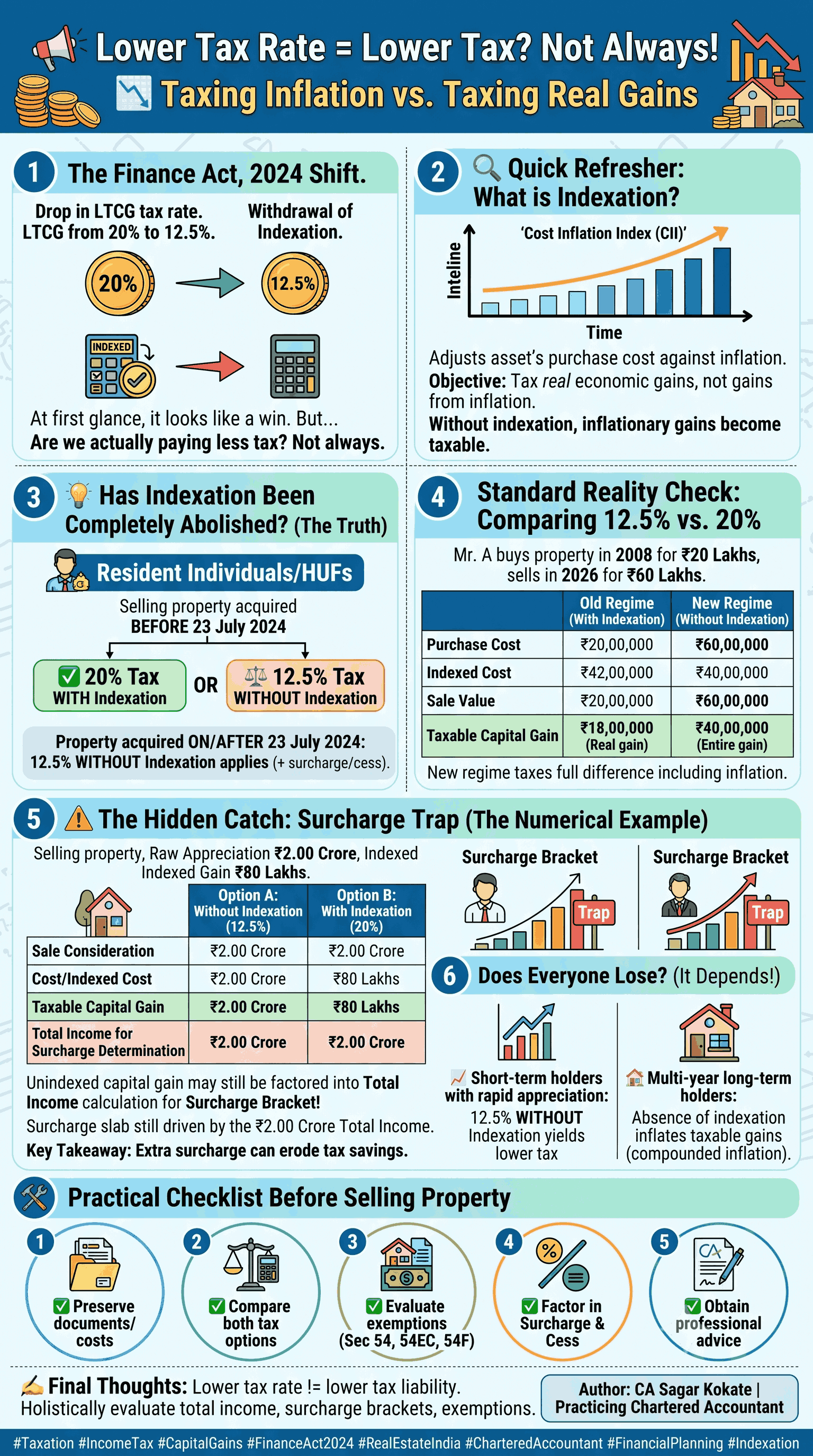
Here is the updated, LinkedIn-ready article with a dedicated breakdown and visual example for The Hidden Catch: Surcharge Trap:
📢 Lower Tax Rate = Lower Tax? Not Always! 📉 Taxing Inflation vs. Taxing Real Gains
The Finance Act, 2024 brought a major shift in Capital Gains Taxation by dropping the Long-Term Capital Gains (LTCG) tax rate on many assets from 20% to 12.5% while simultaneously withdrawing the Indexation benefit in most cases.
At first glance, 12.5% looks like a win. But as taxpayers and investors, the real question we must ask is: "Are we actually paying less tax?"
The short answer: Not always.
🔍 Quick Refresher: What is Indexation?
Indexation adjusts your asset's purchase cost against inflation using the Cost Inflation Index (CII).
- The original goal: Tax real economic gains, not gains created merely by inflation.
- Without indexation: Inflationary gains get taxed, increasing the effective tax burden for long-term holders.
💡 Has Indexation Been Completely Abolished?
No. That’s a common misconception.
For Resident Individuals and HUFs selling land or buildings acquired before 23 July 2024, the law allows you to choose whichever option is more beneficial:
- ✅ 20% Tax WITH Indexation
- ⚖️ 12.5% Tax WITHOUT Indexation
Note: For properties acquired on or after 23 July 2024, indexation is generally removed, and the 12.5% flat rate applies (+ applicable surcharge & cess).
📊 Standard Reality Check: Comparing 12.5% vs. 20%
Scenario: Mr. A bought a property in 2008 for ₹20 Lakhs and sells it in 2026 for ₹60 Lakhs.
|
Particulars |
Old Regime (With Indexation) |
New Regime (Without Indexation) |
|
Purchase Cost |
₹20,00,000 |
₹20,00,000 |
|
Indexed Cost |
₹42,00,000
|
— |
|
Sale Value |
₹60,00,000 |
₹60,00,000 |
|
Taxable Capital Gain |
₹18,00,000 (Real gain)
|
₹40,00,000 (Entire gain)
|
The result: Although a huge portion of the ₹40 Lakh gain is purely inflation, the new regime taxes the full difference.
⚠️ The Hidden Catch: Surcharge Trap (With Numerical Example)
Most taxpayers only compare 20% vs. 12.5% on the base gain. However, even if you opt for 20% with indexation (reducing your taxable gain for tax computation), the unindexed capital gain may still be factored into your Total Income calculation to determine your Surcharge Bracket!
📌 Illustrative Example:
Imagine selling a property where the raw appreciation is ₹2.00 Crore, but after indexation, your real economic gain drops to ₹80 Lakhs:
|
Computation Parameter |
Option A: Without Indexation (12.5%) |
Option B: With Indexation (20%) |
|
Sale Consideration |
₹3.00 Crore |
₹3.00 Crore |
|
Purchase / Indexed Cost |
₹1.00 Crore |
₹2.20 Crore (Indexed)
|
|
Taxable Capital Gain |
₹2.00 Crore
|
₹80 Lakhs
|
|
Total Income for Surcharge Determination |
₹2.00 Crore |
₹2.00 Crore (Unindexed gain considered)
|
|
Applicable Tax Rate |
12.5% |
20% |
|
Surcharge Impact |
Computed considering Total Income of ₹2.00 Crore |
Surcharge slab still driven by the ₹2.00 Crore Total Income
|
Key Takeaway: Even though your tax base under Option B drops to ₹80 Lakhs, your surcharge slab may still be dictated by the unindexed ₹2.00 Crore gain. This extra surcharge can unexpectedly erode your tax savings if you only look at base tax rates!
🎯 Does Everyone Lose?
Not necessarily.
- 📈 Short-term holders with rapid appreciation: If property value grew rapidly in a short span, 12.5% without indexation yields lower tax.
- 🏠 Multi-year long-term holders: The absence of indexation significantly inflates taxable gains due to compounded inflation.
🛠️ Practical Checklist Before Selling Property
Before executing any high-value property transaction:
- ✔️ Preserve all purchase documents and records of improvement costs.
- ✔️ Compare both tax options wherever the law permits.
- ✔️ Evaluate exemptions under Sections 54, 54EC, and 54F.
- ✔️ Factor in the exact impact of Surcharge and Health & Education Cess.
- ✔️ Obtain professional advice before finalizing agreements.
✍️ Final Thoughts
A lower tax rate does not automatically translate into a lower tax liability. Modern tax planning requires evaluating total income, surcharge brackets, and exemption mechanics holistically.
Author: CA Sagar Kokate | Practicing Chartered Accountant
💬 How are you evaluating the new capital gains options for your client portfolios or personal assets? Let's discuss in the comments below! 👇
#Taxation #IncomeTax #CapitalGains #FinanceAct2024 #RealEstateIndia #CharteredAccountant #FinancialPlanning #Indexation
Have Questions? We're Here to Help
Get expert advice from Sagar Kokate & Co. Reach out to discuss your requirements.